

Service · 24 hours a day, every day
Emergency Medical & Surgical Interventions
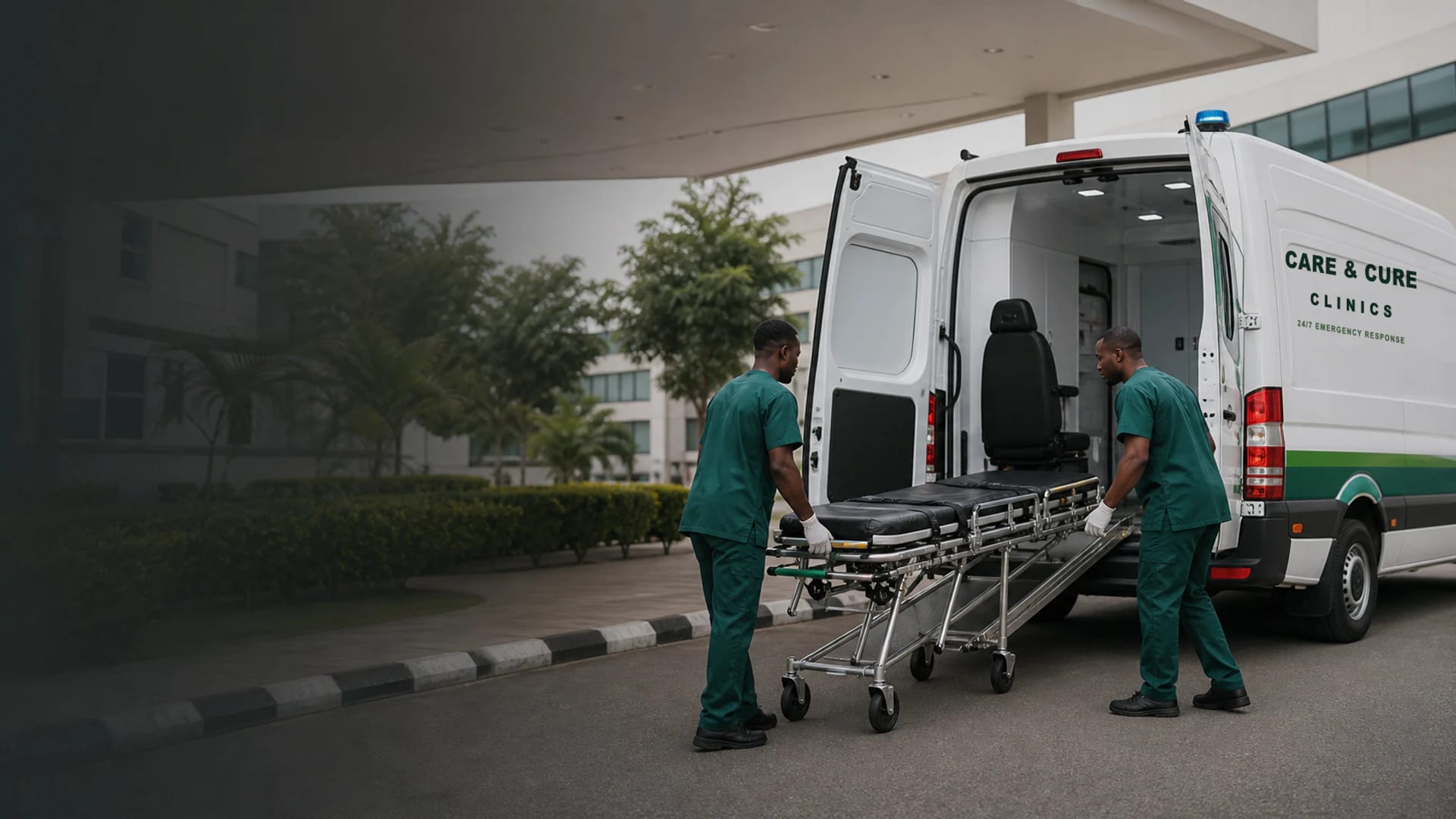
Emergency medicine and emergency surgery under one roof, with our own ambulances and rapid-response riders bringing the patient in. Treatment starts the moment we reach you, not the moment you arrive.
If this is a life-threatening emergency, telephone now
What the emergency service covers
Intervention, not just conveyance
An emergency service that can only move people is an expensive taxi. The first two items below are what make this a hospital emergency service: we can treat and we can operate, immediately.
Resuscitation & emergency medicine
Airway, breathing and circulation stabilised on arrival, with oxygen, intravenous access, drugs and defibrillation immediately available. Assessment is by a clinician, not a queue number.
Emergency surgical intervention
A theatre and an on-call surgical and anaesthetic team are available every hour of the year, for the emergencies where the only effective treatment is an operation.
Ambulance response
Branded, equipped ambulances crewed by two people - a clinician and an emergency medical technician - so treatment begins where the patient is rather than at the door.
Rapid-response riders
Dispatch riders on branded response motorcycles carrying oxygen, airway kit, a defibrillator and drugs. They reach a patient through traffic that stops a vehicle, and start treatment while the ambulance is still on the road.
Inter-facility & specialist transfer
Moving a patient between hospitals for a scan, a procedure or a specialist opinion, with monitoring maintained throughout and the handover documented at both ends.
Discharge & planned conveyance
Collection from a ward and delivery home - safely into the house, not as far as the gate - and planned journeys for patients who cannot travel unaided.
The response fleet
Ambulances and riders, both carrying our name
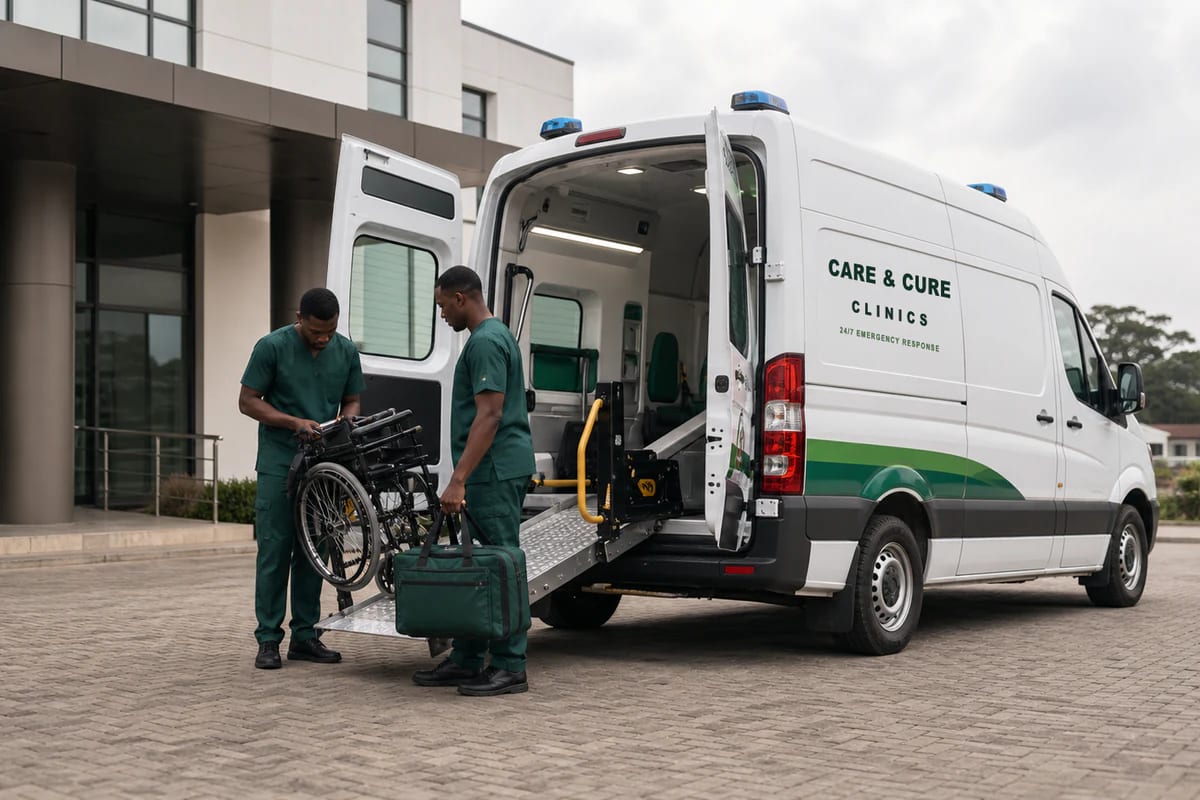
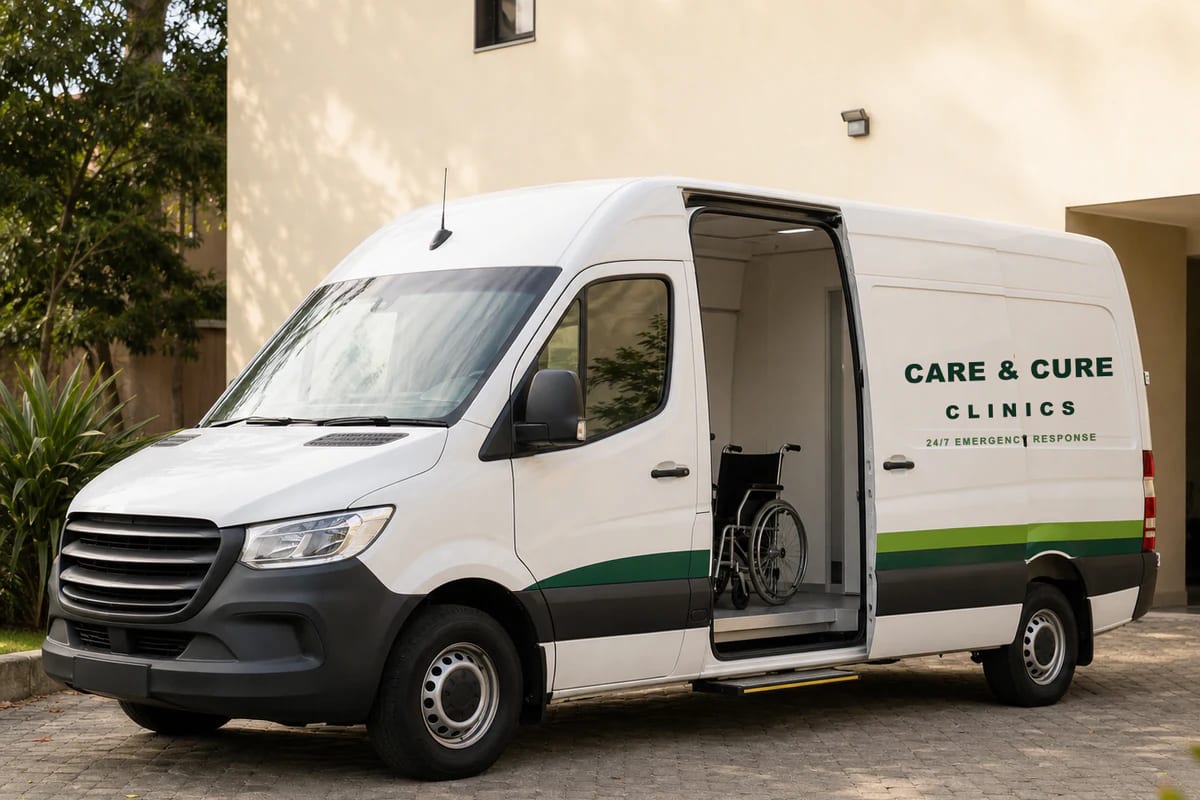
Every vehicle and every rider carries the clinic name and our emergency numbers, so a family flagging us down in the street knows who has arrived and can call the same team again.
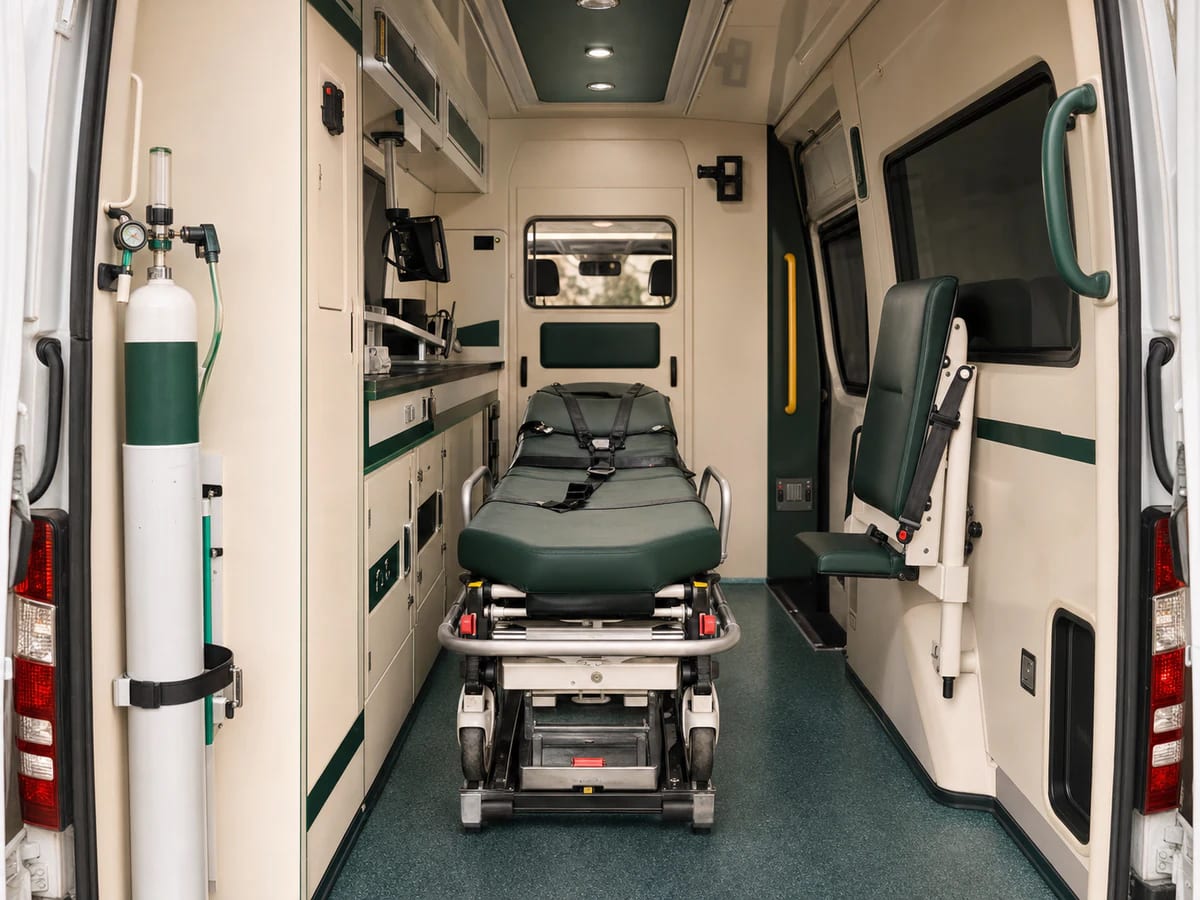
- Two crew on every ambulance, one of them a clinician
- Oxygen, suction, airway and ventilation equipment
- Defibrillator and cardiac monitoring
- Continuous ECG, SpO₂, capnography and blood pressure monitoring
- Emergency drugs, intravenous access and fluids
- Trauma immobilisation and haemorrhage control
- Stretcher and wheelchair as standard in every vehicle
- Infection control and cleaning between every journey
Always open
Open 24 hours a day, seven days a week, including all public holidays. Based at #15 Ikwerre Street, Mile One, Port Harcourt, with transfers between cities and countries arranged on request.
How the emergency response runs
The standards we hold ourselves to
Emergency care is judged on the parts a service actually controls. These are ours, written so you can hold us to them.
- 1
The call is triaged, not just taken
Every emergency call runs through structured emergency medical dispatch: a fixed set of questions that establishes whether the patient is breathing, conscious and bleeding before anything else is discussed. The answers set the priority and tell the crew what they are driving to.
- 2
Activation inside three minutes
We work to the recognised prehospital activation standard - the call assessed and the response tasked within one minute, and the crew mobile within two more. Nothing about that depends on the time of day.
- 3
First aid instructions while you wait
The dispatcher stays on the line and talks the caller through what to do - positioning, bleeding control, chest compressions - because the minutes before the crew arrives are often the ones that decide the outcome.
- 4
Two crew, and the right level of care
Ambulances are double-crewed. Where advanced life support is needed, the responding clinician is qualified to deliver it, with continuous monitoring of ECG, oxygen saturation, end-tidal carbon dioxide and blood pressure en route.
- 5
The receiving team is warned ahead
The hospital or department expecting the patient is briefed by radio or telephone before arrival, so the resuscitation area, the theatre or the scanner is ready rather than being organised on the doorstep.
- 6
Documented handover, and what follows
A written handover at the destination, and where continuing care is part of the plan, the first nursing visit or follow-up appointment is arranged before the crew leaves.
Questions
About emergency care
What to do first, night and holiday cover, response times, and why a motorcycle is sometimes the fastest ambulance.
A WhatsApp call or chat on either number is the fastest way to reach us from any country.
Telephone +234 803 449 4096 or +44 7391 189464 immediately. Both lines are answered 24 hours a day and both accept WhatsApp calls, which connect reliably from any country.
Do not use the booking form to report an emergency - a form waits to be read, a call does not. Stay on the line: the dispatcher will keep talking to you and tell you what to do while the response is on its way.
Yes. Emergency medical and surgical intervention, dispatch and theatre cover run 24 hours a day, seven days a week, every day of the year. There is no closed period and no reduced holiday service.
We will not quote a number we cannot keep, because it depends on where you are and what is already on the road. What we do commit to is the part we control: your call is triaged and a response is tasked within one minute, and the crew is mobile within two more. If we genuinely cannot reach you fast enough, the dispatcher will say so at once and help you get to the nearest facility instead of leaving you waiting.
Both are sent when the call warrants it. A rider gets through congestion that holds up a vehicle and can begin oxygen, airway management, haemorrhage control and defibrillation several minutes earlier - which in a cardiac arrest or a major bleed is the difference that matters. The ambulance follows for the conveyance.
No. Emergency care and patient transport are available to anyone who needs them, whether or not our clinicians have seen you before.
Usually yes, and for a frightened or confused patient it helps considerably. Tell the dispatcher so the crew can plan seating. In a critical emergency the crew may need that space to work.
Longer transfers can be arranged, including transfers to and from other facilities. They need planning around crew hours, equipment and the receiving hospital, so contact us directly to discuss the journey.
Clinical care and immediate life-saving stabilization come first. Once the patient is safely stabilised, our administrative team provides clear, itemised invoicing in consultation with the family or insurance provider.

In an emergency, call. Everything else can be booked.
For a life-threatening emergency, telephone or WhatsApp either number now. For a planned transfer, a discharge journey or an appointment conveyance, book it and tell us what the patient needs.